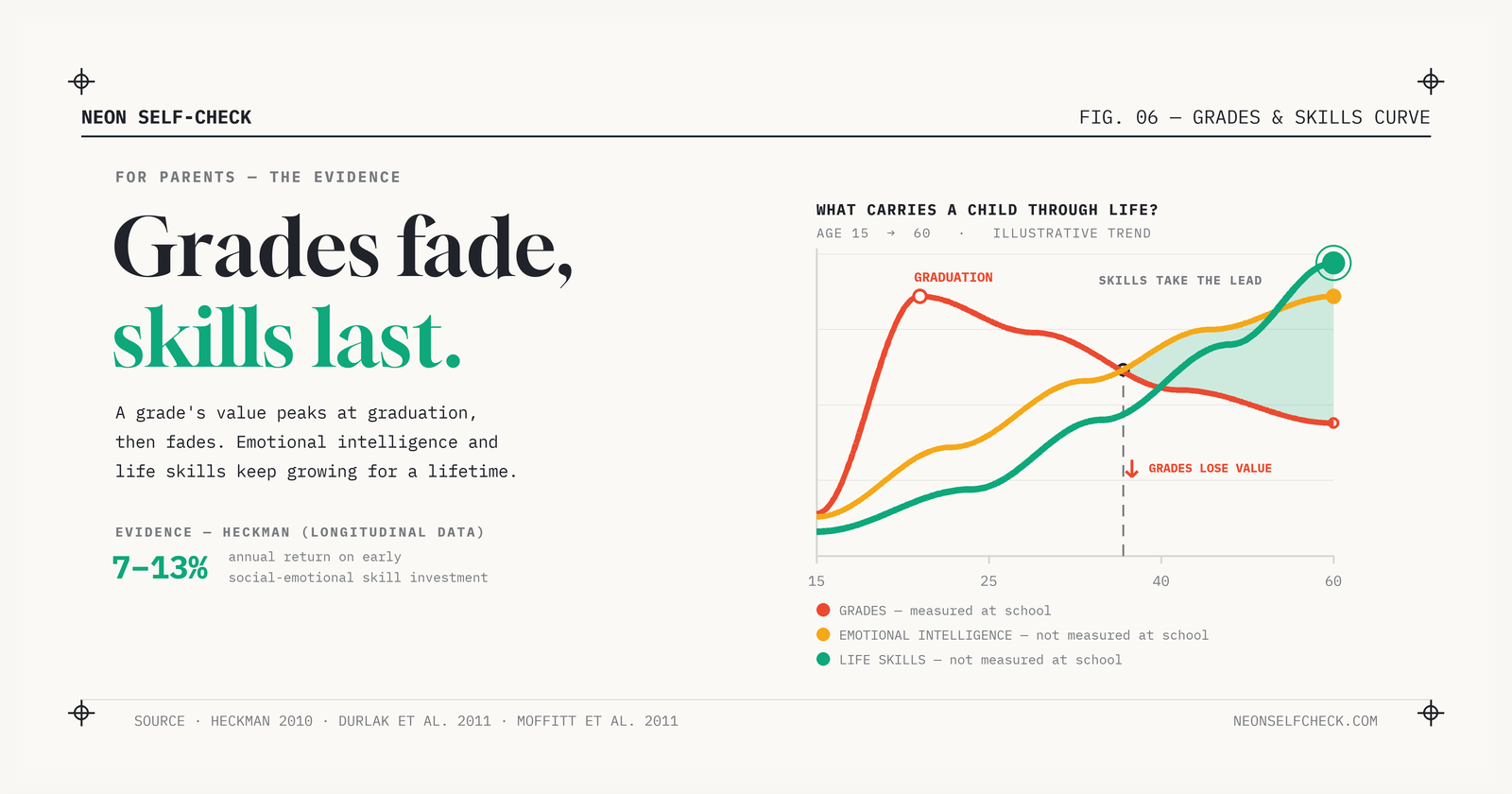
In finance, everyone chases the same question: "Which instrument delivers the highest, most sustainable return at the lowest risk?" Portfolios are managed, risks are analyzed. But what if we applied that same rational, long-horizon mindset to a child's development — and placed a "Grades & Skills Curve" in front of us?
As the chart above shows clearly, economics offers a myth-busting answer. Nobel laureate economist James Heckman's decades-long longitudinal research makes one thing plain: investing early in a child's social-emotional skills yields an annual return of 7 to 13 percent — far above most conventional financial investments.
“Grades fade, skills last — a grade's value peaks at graduation, while emotional intelligence and life skills keep compounding for a lifetime.”
Why Skills, Not Grades?
Look closely at where the red and green curves cross. The value of the grades measured in school peaks around graduation, but once working life and adulthood begin (the 25–40 shift on the chart), that value fades quickly. Meanwhile, the emotional intelligence and life skills that school never measures on their own — a person's ability to manage their inner state, their "quality of being" — compound like a snowball and, by age 60, become the main force carrying life.
The Hard Numbers
These trends aren't a romantic wish or a pedagogical hope; they rest on strong global evidence:
- ✓Academic Lift (Durlak et al., 2011) — A massive meta-analysis of 213 studies found that students in social-emotional learning programs gained an average of 11 percentile points in academic achievement. Emotional intelligence doesn't undermine academics; it fuels them.
- ✓A Predictor of the Future (Moffitt et al., 2011) — The famous Dunedin Study, which followed 1,000 people from childhood into adulthood, found that a child's level of self-control predicts adult health and financial success — independent of IQ and family income.
- ✓What Tomorrow Demands (WEF) — In the World Economic Forum's Future of Jobs report, the most valued and fastest-rising skills are the same ones: resilience, self-awareness, curiosity, and lifelong learning.
Managing a Child's Development Like a Balanced "Life Portfolio"
With a pragmatic, forward-looking lens, we can think of a child's potential as a structured investment portfolio:
1. Academic Grades: Short-Term Liquidity
Measured at school. Visible, short-term returns. They help pass exams and open the door to the next stage. But when they make up the entire portfolio on their own, they are left exposed the moment school ends.
2. Emotional Intelligence (EQ): Long-Term Relationship Capital
Being aware of one's own inner state and building healthy bonds with others. This capital, not directly measured at school, is the foundation of sound decisions in a crisis — and of leadership.
3. Self-Management & Life Skills: The Compound Return of Time
The ability to manage emotions, impulses, and resources. Children who can delay today's instant gratification for tomorrow's bigger goals turn time into a multiplier in their favor — and, like the green curve, keep rising for a lifetime.
4. Learning to Learn: The Portfolio's Multiplier
In an age where the half-life of knowledge has dropped to a few years, knowing how to learn something new is the hidden force that multiplies the value of every other asset in the portfolio.
5. Self-Awareness: The Strategic Signal
A child's ability to see their own strengths, growth areas, and current "inner state." Just as a seasoned investor watches the market to know when to rebalance, a self-aware child learns when to pause and when to accelerate on the road of life.
Remember: every one of these invisible inner assets is learnable and can be developed. And making the investment early buys the highest growth at the lowest "cost."
As a parent, an educator, or a mentor, we cannot build the future by filling a child's life-ledger only with today's "grades." Knowing their inner world, character, and potential through a holistic, analytical approach — and offering the right support at the right time — is vital. Because tomorrow's world will rise on the shoulders of individuals who can manage not what they know, but the "state" they are in, and who notice how they are transforming.
Look at the chart again... As a parent or educator, which curve do you most want to see accelerating in your child's life portfolio today?